I feel like i have learnt some valuable skills and lessons in the three workshops. Non of the paintings or subjects i would have personally chosen to paint but be that as it may the experience is a valuable lesson.
I can't say i like working in oils, as acrylics have always been my preffered choice of medium to use but gaining the skills and insight into how to use them properly is useful just in case i do ever want to try them again.
The large still life painting gave my skills in tonal painting, the Soutine workshop made us think about different ways to approach a painting, whether you focus on tone, line, shape, colour, size or texture, i now know that choosing a couple of these aspects will make you produce a more defined response, rather than trying to tackle every single thing at once.
The colour workshop was probably my favourite, although i don't like the shape painting, i think i would have liked to apply colour to another subject; the experimentation and fighting to urge to use white or black was also good as it taught you how to experiment in the mixing colours to create what you need.
Even though i haven't really liked the content of the paintings we have made i have still learnt some great skills which can then be used and applied to my paintings when i next create a piece, so overall the workshops have been useful in teaching new skills and expanding my understanding of paint as a whole.
Thursday, 17 May 2007
James Elkins: A short course in forgetting chemistry
Elkin argues that painting in a distinctive medium. In what way does he believe it to be distinctive and would you agree with his definition?
Elkin believes that a painting is created without thought, something that the artist can just do distinctively without thought or knowledge of the medium; and that a kind of 'magic' is created through the artist's hand and the paint. He believes an artist can paint without previous experience, like they have never had to be taught how to paint, that it just comes instinctively to them, he calls this 'alchemy', the act of producing something of substance by which no formula can be described.
In a sense i can agree with what Elkin is saying because i do think the act of painting or art in itself, be that drawing or generally being good at creating something comes naturally to a lot of people. For example in a literal sense, i have always been able to draw well however i dont know how i aquired these skills, like Elkin says, i guess it just came naturally to me as a child, and which has been something i have pursued and studied into later life.
I do however feel there are aspects of art you cannot teach yourself, but i do think that art is always an ongoing process of learning and development, i don't think you will EVER reach a stage where you would say to yourself "i know ALL there is to know about art" even the great masters will have died not knowing EVERY single aspect of art or painting.
From studying art at degree level, i know within myself i have been taught things i never knew before, even though i thought i knew everything to know about painting, skills wise, i was suprised to realise there was so much more to learn. Even though the process of painting comes naturally to me as it is what i want to be doing, you realise there is so much more to learn, either from each other, off tutors or by studying other artists.
Painting is a distinctive medium, as the artist creating the painting will have in some way a connection to the painting by that, emotional or physical, and their mood, thoughts or feelings will be reflected through their fingers as they begin to lay the paint. Even the process of actually painting may cause the artist distress, annoyance, confusion or happiness but i feel that whatever they are feeling will always be reflected in their work..if of course it is something they are painting which bares meaning to them.
Elkin's example of Monet is an interesting one as he describes Monet as only being interested in the technicalities of creating a painting, showing the process with vivid brush strokes, and treating figures like "coloured dolls instead of friends or relatives" hence, meaning his paintings had no emotional attachments and his subjects were just another cog in the mechanics of his works. I can't say i am a fan of Monet's work really, and i do tend to like artists who portray meaning into their work. I can't say i have one DEFINITIVE artist who does it for me as everyday i find new artists whose work will grab my attention.....i am not particularly interested in seeing the mechanics of how the painting was made. Far enough, if that is the style of the artist but i prefer my paintings to have meaning, i want to feel something when i look at a painting.....
Not just see how it was made.
Elkin believes that a painting is created without thought, something that the artist can just do distinctively without thought or knowledge of the medium; and that a kind of 'magic' is created through the artist's hand and the paint. He believes an artist can paint without previous experience, like they have never had to be taught how to paint, that it just comes instinctively to them, he calls this 'alchemy', the act of producing something of substance by which no formula can be described.
In a sense i can agree with what Elkin is saying because i do think the act of painting or art in itself, be that drawing or generally being good at creating something comes naturally to a lot of people. For example in a literal sense, i have always been able to draw well however i dont know how i aquired these skills, like Elkin says, i guess it just came naturally to me as a child, and which has been something i have pursued and studied into later life.
I do however feel there are aspects of art you cannot teach yourself, but i do think that art is always an ongoing process of learning and development, i don't think you will EVER reach a stage where you would say to yourself "i know ALL there is to know about art" even the great masters will have died not knowing EVERY single aspect of art or painting.
From studying art at degree level, i know within myself i have been taught things i never knew before, even though i thought i knew everything to know about painting, skills wise, i was suprised to realise there was so much more to learn. Even though the process of painting comes naturally to me as it is what i want to be doing, you realise there is so much more to learn, either from each other, off tutors or by studying other artists.
Painting is a distinctive medium, as the artist creating the painting will have in some way a connection to the painting by that, emotional or physical, and their mood, thoughts or feelings will be reflected through their fingers as they begin to lay the paint. Even the process of actually painting may cause the artist distress, annoyance, confusion or happiness but i feel that whatever they are feeling will always be reflected in their work..if of course it is something they are painting which bares meaning to them.
Elkin's example of Monet is an interesting one as he describes Monet as only being interested in the technicalities of creating a painting, showing the process with vivid brush strokes, and treating figures like "coloured dolls instead of friends or relatives" hence, meaning his paintings had no emotional attachments and his subjects were just another cog in the mechanics of his works. I can't say i am a fan of Monet's work really, and i do tend to like artists who portray meaning into their work. I can't say i have one DEFINITIVE artist who does it for me as everyday i find new artists whose work will grab my attention.....i am not particularly interested in seeing the mechanics of how the painting was made. Far enough, if that is the style of the artist but i prefer my paintings to have meaning, i want to feel something when i look at a painting.....
Not just see how it was made.
Monday, 7 May 2007
Painting - My Opinion
I feel that painting is a personal experience, whether that is finding inspiration for the piece, choosing a memory, personal experience or whether it is simply using your imagination to come to a decision, a painting will always come from within. Whether that is how you are feeling having an influence on your work; for example i recall in 6th form not being very happy, not that i was depressed, but a recent personal worry made me feel low and i reached for the black paint; all my paintings were sad and dark. I was painting how i felt confused and depressed. It wasnt a deliberate act, maybe it was an unconscious reaction...
So whether this reaction comes from within, consciously or unconsciously, it is something which only the artist can decide on. Every mark, every detail, colour, subject, is their own decision (unless of course you have a commission).
Everytime i paint, i feel it is a unique experience, between me and the canvas, and sometimes i can sit and stare at a painting for hours wondering what it is doing to me, or simply to just decide where it needs to go next. I can be haunted sometimes by trying to decide what to do with the piece. For example, i recently painted my next door neighbour's children as a commission, and for days i sat and stared at the painting, it was like my own personal hell, trying to get their faces perfect and in proportion. Everytime i shut my eyes all i could see was the painting, like it was inscribed on the back of my eyelids.
You can get lost in a painting, in both creating one and looking at one. Painting it a personal experience, for both the artist and the viewers, it has the ability to affect us all differently and cause reactions and evoke feelings from all sides of the coin.
For my neighbours who were over the moon with their painting and cannot take their eyes off it, for me the artist who painted it, it was a torment which haunted me, i also couldnt take my eyes off it, but for a completely different reason.
Paintings can affect us all differently and with that example alone, im sure many others have experienced this also.
So there lies an example of what painting can do to you, i have found this using other mediums too but for me, and my own experience with painting, i like to paint a reality, i find it hard to paint what isn't there, or cannot be seen. Frida Kahlo once said "i paint my own reality - i paint what is real to me", something which i can really relate to.
So whether this reaction comes from within, consciously or unconsciously, it is something which only the artist can decide on. Every mark, every detail, colour, subject, is their own decision (unless of course you have a commission).
Everytime i paint, i feel it is a unique experience, between me and the canvas, and sometimes i can sit and stare at a painting for hours wondering what it is doing to me, or simply to just decide where it needs to go next. I can be haunted sometimes by trying to decide what to do with the piece. For example, i recently painted my next door neighbour's children as a commission, and for days i sat and stared at the painting, it was like my own personal hell, trying to get their faces perfect and in proportion. Everytime i shut my eyes all i could see was the painting, like it was inscribed on the back of my eyelids.
You can get lost in a painting, in both creating one and looking at one. Painting it a personal experience, for both the artist and the viewers, it has the ability to affect us all differently and cause reactions and evoke feelings from all sides of the coin.
For my neighbours who were over the moon with their painting and cannot take their eyes off it, for me the artist who painted it, it was a torment which haunted me, i also couldnt take my eyes off it, but for a completely different reason.
Paintings can affect us all differently and with that example alone, im sure many others have experienced this also.
So there lies an example of what painting can do to you, i have found this using other mediums too but for me, and my own experience with painting, i like to paint a reality, i find it hard to paint what isn't there, or cannot be seen. Frida Kahlo once said "i paint my own reality - i paint what is real to me", something which i can really relate to.
Collings: The Inner Life of Painting
Collings has stated that the art of today has no connection to the past ‘in any real way’ implying that art has transformed into its own 'world' with no connections to the world as we know it.
He goes onto state that art today is mostly ‘visually boring’.....
Art will always have connections to the past. Egon Schiele once quoted "Art cannot be modern.. Art is primordially eternal".
Meaning that what is labelled as modern today will once become a thing of the past until art reaches further new realms and quashes what we consider to be modern in this present day.
I can see Colling's viewpoint in that some people believe that art is simply represented through paint, and that these days a pickled animal is considered as art, whether i believe this to be true or not is irrelevant. There does seems to be a lack of paintings and people recognised for having a great skill in that area coming to the forefront of the art world. Take the Turner Prize for example, since 1984 untill the present day, have only 4 people won on the merit of painting, and we celebrate weird and wonderful pieces such as un-made beds, transexual inspired decorated ceramics, video installations, pickled animals and wooden sheds which turn into a boat.
To people who know nothing about art, i can understand their fears and comments on the irrelevance of art when we award prizes to such exhibits and to be honest sometimes i am inclined to agree. It is no wonder that the comments are made that art does not connect to the past, but when art develops and moves on and we learn of weirder and more exciting artists and works coming to the forefront of the art world we can only embrace it, whether we like it or not.
He goes onto state that art today is mostly ‘visually boring’.....
Art will always have connections to the past. Egon Schiele once quoted "Art cannot be modern.. Art is primordially eternal".
Meaning that what is labelled as modern today will once become a thing of the past until art reaches further new realms and quashes what we consider to be modern in this present day.
I can see Colling's viewpoint in that some people believe that art is simply represented through paint, and that these days a pickled animal is considered as art, whether i believe this to be true or not is irrelevant. There does seems to be a lack of paintings and people recognised for having a great skill in that area coming to the forefront of the art world. Take the Turner Prize for example, since 1984 untill the present day, have only 4 people won on the merit of painting, and we celebrate weird and wonderful pieces such as un-made beds, transexual inspired decorated ceramics, video installations, pickled animals and wooden sheds which turn into a boat.
To people who know nothing about art, i can understand their fears and comments on the irrelevance of art when we award prizes to such exhibits and to be honest sometimes i am inclined to agree. It is no wonder that the comments are made that art does not connect to the past, but when art develops and moves on and we learn of weirder and more exciting artists and works coming to the forefront of the art world we can only embrace it, whether we like it or not.
Films.....
Derek Jarmen portrayed Caravaggio as a rogue and showed how his hedonistic lifestyle related to his paintings; he tended to paint realisitically and portray life as he saw it, which at the time he was working, people didn't appreciate.
Some of his pieces which he painted for the church was often refused because of his rebel life style; this passion and rebelliousness was reflected strongly in the film.
The film was based on the story of his life; the theatre and stage settings were carefully constructued in a way that sometimes you thought you were staring at a painting, however it was just the actors posing in dim lights, standing perfectly still. It was really amazing how the screen play could depict such precision.It felt as though the film was showing a moving painting with every shot, deliberatly posed.
I did feel as though the film didn't really tell you that much about his work, more the face behind it although i guess Jarmen was trying to show the rebel behind the work and make us further understand his life and how this influenced his works. The film was interesting and I feel Caravaggio was portrayed as an extremely passionate artist.
The stories he made up that went with the maps were really far fetched and amusing (only because i did not realise he was making them up) but they just became REALLY irritating and i shut off from listening and watching.
The Jean-Luc Godard film was much more interesting, a shame it had subtitles as i felt i wanted to know what was being said, but lost concentration on the pictures. I thought it was a beautiful film, really deep and insightful. I remember specifically the end of the film where it showed the stages of painting and the different layering that it took on until it reached an outcome, which was intriguing to say the least, i could not believe how many times the painting was worked over until it was finished!!
Thursday, 26 April 2007
Final Painting Workshop
For this workshop we were asked to prepare an A1 canvas and to bring in paints, oil or acrylic colours but NO black or white.
We were given a bag of foam shapes and asked to prepare either a 3D composition using wire or to make a flat composition on a white sheet of paper, i chose the flat piece and i don't really like working from 3D objects.
Here is my composition...
 I have layered the shapes to create depth and tried to cover the whole white paper so i wouldn't have to deal with 'white' background showing through, where there is slight amounts showing, i drew the shapes on larger to eliminate this.
Unfortunately (being the wally i am) i forgot to document the on-going process while i was building the layers up, however, i started by making a yellow wash and drawing on the shapes lightly with the paint. Then basically using the colours i had with me, added washes to the shapes using the corresponding colours. I didn't really get that much done during the day and come the end of the lesson wasn't really taken with my effort so far.
Yesterday at home however, i built up the painting, having previously bought better colours and paints from Studio Arts in town.
I kept referring to Howard Hodgkin and the style he paints in to try and make something decent of my painting. This is not what i would normally choose to paint at all and i kept feeling disappointed in myself at the direction the painting was going in, i knew it needed 'something' to bring it to life.
I experiment with brush strokes and building similar colours up over each other, instead of just painting in block colour, in a sense it added tone and depth to the piece.


 Here in these images you can see the colours layered over each other and the quite 'brushy' lines still evident.
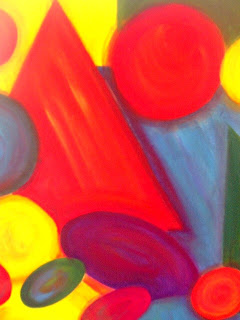
While i was completing this painting i was looking at artists such as Howard Hodgkin and Mark Rothko who both use copious amounts of colour in their work, they are renowned for their use of colour in their painting styles. In particular i studied Hodgkin's brush movements and his layerings of colours and replicated this on the shapes so they didnt just sit flat on the canvas. I varied the brush sizes as well to give a greater definition to some of the marks. Hodgkin's has a very unique painting style though, so it wasn't a case of trying to copy him, more of taking his style and adapting in in my own work to a lesser extent. Here are some examples of their work....
 Howard Hodgkin

Howard Hodgkin

Howard Hodgkin
 Mark Rothko
 Mark Rothko
 Mark Rothko
We were given a bag of foam shapes and asked to prepare either a 3D composition using wire or to make a flat composition on a white sheet of paper, i chose the flat piece and i don't really like working from 3D objects.
Here is my composition...
 I have layered the shapes to create depth and tried to cover the whole white paper so i wouldn't have to deal with 'white' background showing through, where there is slight amounts showing, i drew the shapes on larger to eliminate this.
Unfortunately (being the wally i am) i forgot to document the on-going process while i was building the layers up, however, i started by making a yellow wash and drawing on the shapes lightly with the paint. Then basically using the colours i had with me, added washes to the shapes using the corresponding colours. I didn't really get that much done during the day and come the end of the lesson wasn't really taken with my effort so far.
Yesterday at home however, i built up the painting, having previously bought better colours and paints from Studio Arts in town.
I kept referring to Howard Hodgkin and the style he paints in to try and make something decent of my painting. This is not what i would normally choose to paint at all and i kept feeling disappointed in myself at the direction the painting was going in, i knew it needed 'something' to bring it to life.
I experiment with brush strokes and building similar colours up over each other, instead of just painting in block colour, in a sense it added tone and depth to the piece.


 Here in these images you can see the colours layered over each other and the quite 'brushy' lines still evident.
While i was completing this painting i was looking at artists such as Howard Hodgkin and Mark Rothko who both use copious amounts of colour in their work, they are renowned for their use of colour in their painting styles. In particular i studied Hodgkin's brush movements and his layerings of colours and replicated this on the shapes so they didnt just sit flat on the canvas. I varied the brush sizes as well to give a greater definition to some of the marks. Hodgkin's has a very unique painting style though, so it wasn't a case of trying to copy him, more of taking his style and adapting in in my own work to a lesser extent. Here are some examples of their work....
 Howard Hodgkin
Howard Hodgkin

Howard Hodgkin
 Mark Rothko
 Mark Rothko
 Mark Rothko
Sunday, 15 April 2007
Final Response
This morning i started my final piece in response to the Soutine Painting. Using a viewfinder i reduced the original image to this, as i felt that even though the painting had been dramatically reduced, that there was still enough information within this reduced version to still grasp the painting.

Side of Beef and Calf's Head by Chaim Soutine. Oil on canvas 92x73cm 1923
So this above smaller version is what i have been concentrating on whist completing a painted study of the piece. For this last final attempt, i cut down the A1 mount to A2 size and instantly knew that this scale was much better for me to work on.
I started off as usual, defining the darkest area and then building up tone with burnt sienna and then going over the tone with its matching colour counterpart, working over the image as a whole instead of just concentrating on one area at a time.

 Gradually i built up the carcass area, using the colours to match the undertones....
 And kept on going, trying to concentrate on the lines to build up the tones and colour to create the image.

 Then i spent the rest of the time building it up more and more, using varied brushes to create differing lines,

 I am going to go back to this piece in a few days, as just looking at it now, i can see areas i'm not happy with, and it gives me a chance to reassess the piece with fresher eyes. But here is the piece so far in its entirety....

 Comparing it to the Soutine, i can see his tones are less vibrant than what i have created in my piece, so i feel a re-visit is needed in a few days....just to touch it up.

Side of Beef and Calf's Head by Chaim Soutine. Oil on canvas 92x73cm 1923
So this above smaller version is what i have been concentrating on whist completing a painted study of the piece. For this last final attempt, i cut down the A1 mount to A2 size and instantly knew that this scale was much better for me to work on.
I started off as usual, defining the darkest area and then building up tone with burnt sienna and then going over the tone with its matching colour counterpart, working over the image as a whole instead of just concentrating on one area at a time.

 Gradually i built up the carcass area, using the colours to match the undertones....
 And kept on going, trying to concentrate on the lines to build up the tones and colour to create the image.
 Then i spent the rest of the time building it up more and more, using varied brushes to create differing lines,
 I am going to go back to this piece in a few days, as just looking at it now, i can see areas i'm not happy with, and it gives me a chance to reassess the piece with fresher eyes. But here is the piece so far in its entirety....
 Comparing it to the Soutine, i can see his tones are less vibrant than what i have created in my piece, so i feel a re-visit is needed in a few days....just to touch it up.
 Saturday, 14 April 2007
Starting the Final Piece
This afternoon i decided to start my final piece, choosing to use the whole A1 mount card, which turned out to be mistake!!!!!
I started by defining the black areas....

Then using orange mixed with a burnt sienna lightly started to define the tone...
 Then as instructed, and having done previous attempts with the test pieces, began to build up the colour, then it just started going downhill.
 I don't know whether this was because i was tired but the picture as a whole i felt just wasn't working on the A1 scale and every subsequent mark i made, just made it look worse.
 And sooooo having documented with photographs, the evidence of this attempt, i decided to turn over the mount card, prime it ready to REDUCE the scale to A2 for tomorrow attempts.
Don't get me wrong there were some lovely areas with the carcass area like this pictured below, but as a WHOLE painting it just looked awful. I guess that it was a case of trying the scale to know it wasn't right, so i can only learn from this experience.

I started by defining the black areas....

Then using orange mixed with a burnt sienna lightly started to define the tone...
 Then as instructed, and having done previous attempts with the test pieces, began to build up the colour, then it just started going downhill.
 I don't know whether this was because i was tired but the picture as a whole i felt just wasn't working on the A1 scale and every subsequent mark i made, just made it look worse.
 And sooooo having documented with photographs, the evidence of this attempt, i decided to turn over the mount card, prime it ready to REDUCE the scale to A2 for tomorrow attempts.
Don't get me wrong there were some lovely areas with the carcass area like this pictured below, but as a WHOLE painting it just looked awful. I guess that it was a case of trying the scale to know it wasn't right, so i can only learn from this experience.

Another Line Test
I decided to experiment again with using line as i think i preferred a previous line test to just using colour to build up the tone. Here are some images, on an A4 scale of the painting using line and also slight amounts of texture which i created by applying the paint really thick.


 Final thoughts before tackling the 'final' response, is that i will be using line and painting in colour. With regards to the scale, i think that this painting doesn't need to be huge, so i think i will paint it A2 size, approximately the size of the original one and also giving me scope to use larger brushes to gain varied lines.


 Final thoughts before tackling the 'final' response, is that i will be using line and painting in colour. With regards to the scale, i think that this painting doesn't need to be huge, so i think i will paint it A2 size, approximately the size of the original one and also giving me scope to use larger brushes to gain varied lines.
Wednesday, 11 April 2007
Scale
Having done the previous tests on A3 scale i decided trying a really small scale, maybe around the size of A5, if not that...just to see how well the painting would come out at a smaller scale. Here is how it came out.....

 I quite like this small scale but i don't think i will do my final piece at such a small size as it was really hard to paint, plus i prefer working on a large scale...
I'm also thinking i would like to do my painting in line and colour, just concentrating on those two aspects primarily...

 I quite like this small scale but i don't think i will do my final piece at such a small size as it was really hard to paint, plus i prefer working on a large scale...
I'm also thinking i would like to do my painting in line and colour, just concentrating on those two aspects primarily...
Sketches
Here are the sketched tests we did in the lesson, exploring tone, line, shape, scale and texture, to get a feel for the larger painted piece. I guess this was a useful exercise but i hate drawing with a pencil and felt really restricted using just the pencil to make the marks, but in a way it was good for an initial response.


Soutine Painting
These are the tests am i doing in preparation for tackling my final response to the Soutine painting from the Carcuss Series, pictured here. Laura said we could tackle the painting either concentrating on tone, colour, line, texture or shape; i decided to do about four or so tests to determine what was working and what wasn't.
 This one here, i used burnt umber to respond tonally to the piece. Also using a viewfinder have cut down the image to what i have painted here, as i didn't like the piece as a whole but still feel that there is more than enough information in this reduced version to still understand the painting and what the imagery conveys. I think that this tonal piece worked well, but i found it hard using tone in just one colour.


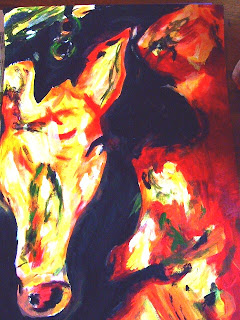
These pieces above are responses in colour; i just concentrated using the colours to create the depth and tone in the original piece.
 This painting here, was a line response, using only line to create the tone and depth of the painting. I found i liked representing the piece in line and definitely want to use colour as well for the final piece.
My thoughts on this piece, is that i'm not sure i like it as a painting, firstly the subject matter is quite grotesque, it's not like i am disgusted by it or anything, i just wouldnt want it on my wall. The palette is limited and quite dull, it is just not a painting that brings me any interest or joy. I do think it has strong imagery, and a definate theme to it, and the darker background really emphasises the shape of the carcuss and brings out the colours in the head of the calf.
To be honest i cant really relate to this painting, this is not what i would ever choose to paint, given the choice, i personally like to be quite realistic with my painting and this style of painting, quiet gestural, with the brush strokes showing doesnt appeal to me, maybe on a different subject but definately not this.
When i have been responding to this piece, initially in the class i was more trying to copy it rather than respond and i know sometimes that this is a problem for me, but choosing to use line, or scale or tone as a certain aspect to concentrate on really helps as you tend to concentrate on the formal property rather than trying to do a mark for mark perfect copy.
 Laura said we could tackle the painting either concentrating on tone, colour, line, texture or shape; i decided to do about four or so tests to determine what was working and what wasn't.
 This one here, i used burnt umber to respond tonally to the piece. Also using a viewfinder have cut down the image to what i have painted here, as i didn't like the piece as a whole but still feel that there is more than enough information in this reduced version to still understand the painting and what the imagery conveys. I think that this tonal piece worked well, but i found it hard using tone in just one colour.


These pieces above are responses in colour; i just concentrated using the colours to create the depth and tone in the original piece.
 This painting here, was a line response, using only line to create the tone and depth of the painting. I found i liked representing the piece in line and definitely want to use colour as well for the final piece.
My thoughts on this piece, is that i'm not sure i like it as a painting, firstly the subject matter is quite grotesque, it's not like i am disgusted by it or anything, i just wouldnt want it on my wall. The palette is limited and quite dull, it is just not a painting that brings me any interest or joy. I do think it has strong imagery, and a definate theme to it, and the darker background really emphasises the shape of the carcuss and brings out the colours in the head of the calf.
To be honest i cant really relate to this painting, this is not what i would ever choose to paint, given the choice, i personally like to be quite realistic with my painting and this style of painting, quiet gestural, with the brush strokes showing doesnt appeal to me, maybe on a different subject but definately not this.
When i have been responding to this piece, initially in the class i was more trying to copy it rather than respond and i know sometimes that this is a problem for me, but choosing to use line, or scale or tone as a certain aspect to concentrate on really helps as you tend to concentrate on the formal property rather than trying to do a mark for mark perfect copy.
Sunday, 1 April 2007
Approaching the Painting
I approached this piece well i thought, the tonal aspect when it was announced threw me slightly but once i got into the swing of things, highlighting the darkest areas and the lightest and then working in the mid-tones, it seemed to flow pretty well.
I started off with a light grey wash, outlining the image, working quickly and swiftly as it was only the outline, which only needed defining vaguely to allow me to work more into the actual tone.
From then on, i just got on with it and painted just what i saw, mainly concentrating on tone.
Laura said we could use some charcol if we wanted to, so then i used the charcol to define some areas but ended up using it to define the edges against the background.
The background as previously explained, i wanted to keep minimal as to keep the object the main focus, i didn't want to paint the background as i saw it, behind the still life, as i felt this would distract from the actual object.
I revisited the painting a few days after spending the whole day working on it, to reasses what was going on in the piece and add some final lighter tones to it, with fresh amounts of paint.
When i approach painting i always do an outline in a wash, which is exactly what i did here on this piece. I tend to paint quite life-like, not the extent of say photo-realism but i like people to know what it is i have painted and i guess that is how i paint and the style i paint in, and this has been carried into this piece.
I can't say i liked using the oils in this context on raw canvas as it was hard work; i tend to paint using acrylics myself as had actually never used oils before. I think i handled them well though, and managed to apply them well, although trying to thin them out was hard work.
In relation to the Berger essay, i just saw what i saw and interpreted the object in my own way, in my own style and how i saw the still life there and then on the day. We were all a little preoccupied by the fact the piece looked like somone from the KKK, a white hooded figure; was a little distracting and may influence what a viewer would describe it as too.
I started off with a light grey wash, outlining the image, working quickly and swiftly as it was only the outline, which only needed defining vaguely to allow me to work more into the actual tone.
From then on, i just got on with it and painted just what i saw, mainly concentrating on tone.
Laura said we could use some charcol if we wanted to, so then i used the charcol to define some areas but ended up using it to define the edges against the background.
The background as previously explained, i wanted to keep minimal as to keep the object the main focus, i didn't want to paint the background as i saw it, behind the still life, as i felt this would distract from the actual object.
I revisited the painting a few days after spending the whole day working on it, to reasses what was going on in the piece and add some final lighter tones to it, with fresh amounts of paint.
When i approach painting i always do an outline in a wash, which is exactly what i did here on this piece. I tend to paint quite life-like, not the extent of say photo-realism but i like people to know what it is i have painted and i guess that is how i paint and the style i paint in, and this has been carried into this piece.
I can't say i liked using the oils in this context on raw canvas as it was hard work; i tend to paint using acrylics myself as had actually never used oils before. I think i handled them well though, and managed to apply them well, although trying to thin them out was hard work.
In relation to the Berger essay, i just saw what i saw and interpreted the object in my own way, in my own style and how i saw the still life there and then on the day. We were all a little preoccupied by the fact the piece looked like somone from the KKK, a white hooded figure; was a little distracting and may influence what a viewer would describe it as too.
John Berger: Once in a Painting
John Berger states in his essay...
"The difference is in what the painting delivers: in how closely the moment of it being looked at, as foreseen by the painter, corresponds to the interests of the actual moments of its being looked at by other people, when the circumstances surrounding its production have changed."
I feel this sums up what I was trying to explain in my previous post, everyone is going to have a different opinion on the painting and people's reaction to art is always going to differ. There isn't one simple answer or response to a piece of art, what one person believes another may totally contradict and disagree with their views.
So of course, someone passing judgement on our pieces, or any piece of art for that matter who doesnt know the intention and stages of production may be at a loss as to what they are seeing. Most people's reaction in this case is "i don't get it", "i don't understand" and usually "oh i don't like it, my 5 year old could do that". It is REALLY annoying as an artist if someone passes such a judgement on your work.
With regards to the piece we have just produced, the still life with Laura, the object appears to be very figurative, and a lot of people interpreted it in this way, although when we went around the class marking each other's work, on Trine's painting the 'figure' looked like a massive rock amongst a landscape, whether she intended this or not, i don't know? Yet she painted exactly what the rest of us had painted; this is an example of what Berger is trying to say in his essay.
"The difference is in what the painting delivers: in how closely the moment of it being looked at, as foreseen by the painter, corresponds to the interests of the actual moments of its being looked at by other people, when the circumstances surrounding its production have changed."
I feel this sums up what I was trying to explain in my previous post, everyone is going to have a different opinion on the painting and people's reaction to art is always going to differ. There isn't one simple answer or response to a piece of art, what one person believes another may totally contradict and disagree with their views.
So of course, someone passing judgement on our pieces, or any piece of art for that matter who doesnt know the intention and stages of production may be at a loss as to what they are seeing. Most people's reaction in this case is "i don't get it", "i don't understand" and usually "oh i don't like it, my 5 year old could do that". It is REALLY annoying as an artist if someone passes such a judgement on your work.
With regards to the piece we have just produced, the still life with Laura, the object appears to be very figurative, and a lot of people interpreted it in this way, although when we went around the class marking each other's work, on Trine's painting the 'figure' looked like a massive rock amongst a landscape, whether she intended this or not, i don't know? Yet she painted exactly what the rest of us had painted; this is an example of what Berger is trying to say in his essay.
When is a painting complete?
This seems to have been a burning issue amongst the group lately as we heard along the grapevine that Laura didn't seem to think any of our large paintings of the still life were finished, which of course, being more experienced maybe she noticed things we didn't in our work.
I feel that this is a very SUBJECTIVE issue as the artist may intend to paint something in a specific way which may arouse the issue in its viewers, critics, that their work isn't finished.
When i think about my piece, posted below, i know i really wanted the background to be minimal and keep the focus on the 'figure' (if you will) but after hearing that it wasn't apparently finished it made me think twice to reasses the painting.
Ok so i have followed the criteria, i've filled the canvas, got the image on there and done a tonal black and white representation of the image.
The criteria, which i am reading now states 'pay special attention to the relationship between the object and the background and the definition of the edges'.
Now some may argue i have drawn the image on and used charcol to define the edges, and that they are 'no such things as outlines' but i wanted to keep quite a drawn feel to the image. In fact it was only after the application of paint did i use the charcol, i started out with a wash of oil which outlined the object.
Anyway, over Easter i am going to look at the piece again and see what else may need doing to it.....my only concern with the background is that when i've seen other members of the groups work with full background, it has distracted from the image, which i really don't want to do as i feel i have produced a strong piece.
SO when is a painting finished?
Well, from experience, it is when i feel i have come to a point where anymore work would spoil it and know i have sometimes pushed this boundary too far and ruined previous works.
I take a step back and constantly reasses my work and keep revisiting it, a few days afterwards sometimes for a fresh outlook.
Sometimes you just get a feeling about your work, like an intuition that it needs 'something' more. But i can't give a definate answer, not because i don't know; maybe i don't know how to express what i mean, but my main reason is that you have to take into account the artists's intentions, who are we to question their work? We can give a critical response and an analytical response, but we cannot account for their reasonings.
Yes, we have been given a criteria to follow, but as artists do we have to follow this inclusively? Or is there room for indiviuality and personal response?
It's all pretty confusing, as i dont believe there is a definate answer to this, i just think you know in yourself, as an artist, knowing your own intentions...
Until someone comes along and tells you otherwise............
I feel that this is a very SUBJECTIVE issue as the artist may intend to paint something in a specific way which may arouse the issue in its viewers, critics, that their work isn't finished.
When i think about my piece, posted below, i know i really wanted the background to be minimal and keep the focus on the 'figure' (if you will) but after hearing that it wasn't apparently finished it made me think twice to reasses the painting.
Ok so i have followed the criteria, i've filled the canvas, got the image on there and done a tonal black and white representation of the image.
The criteria, which i am reading now states 'pay special attention to the relationship between the object and the background and the definition of the edges'.
Now some may argue i have drawn the image on and used charcol to define the edges, and that they are 'no such things as outlines' but i wanted to keep quite a drawn feel to the image. In fact it was only after the application of paint did i use the charcol, i started out with a wash of oil which outlined the object.
Anyway, over Easter i am going to look at the piece again and see what else may need doing to it.....my only concern with the background is that when i've seen other members of the groups work with full background, it has distracted from the image, which i really don't want to do as i feel i have produced a strong piece.
SO when is a painting finished?
Well, from experience, it is when i feel i have come to a point where anymore work would spoil it and know i have sometimes pushed this boundary too far and ruined previous works.
I take a step back and constantly reasses my work and keep revisiting it, a few days afterwards sometimes for a fresh outlook.
Sometimes you just get a feeling about your work, like an intuition that it needs 'something' more. But i can't give a definate answer, not because i don't know; maybe i don't know how to express what i mean, but my main reason is that you have to take into account the artists's intentions, who are we to question their work? We can give a critical response and an analytical response, but we cannot account for their reasonings.
Yes, we have been given a criteria to follow, but as artists do we have to follow this inclusively? Or is there room for indiviuality and personal response?
It's all pretty confusing, as i dont believe there is a definate answer to this, i just think you know in yourself, as an artist, knowing your own intentions...
Until someone comes along and tells you otherwise............
Sunday, 18 March 2007
Life Drawing
The following Tuesday we had a life drawing session with Andrea which I really enjoyed! I love being able to draw the human form from real life and gain this experience. Today we used a variety of materials, including stick and ink, graphite with linseed oil and pastels, and produced some layered material images.
 Stick and Ink Drawing, layered with Graphite and Linseed Oil
 Coloured Pastel Tonal Drawing, Defined with Stick and Ink Contours
 Stick and Ink, Graphite and Linseed Oil Drawing
 Stick and Ink Drawing, layered with Graphite and Linseed Oil
 Coloured Pastel Tonal Drawing, Defined with Stick and Ink Contours
 Stick and Ink, Graphite and Linseed Oil Drawing
I really enjoy the life drawing as I am really interested in the human figure's representation in art. My favourite material that we used today was the Graphite smudged using the Linseed Oil and it produced some rich tonal marks. I also spent most of the day drawing with my left hand (not my dominant right hand) as i love producing some less structured marks, as you have less control over your mark making and sometimes I feel these produce better marks.


Still Life
This still life piece was set up for us to work from during a painting session with Laura. We were told to paint a black and white tonal painting, using white oil paint, and a black colour consisting of a mixture of cobalt blue and burnt umber oil.

I drew out the basic shape with charcoal and then got to work identifying the darkest areas first, and then taking the darkest black I made from the two colour mixture, added small amounts of the white to produce the shade lighter...and so forth.
Here is the piece i produced from this angle....


 I wanted to leave the background quite minimal as i wanted to keep the attention drawn to the 'figure' and also because I tailored my painting to have a drawn aspect to it by going over with the charcoal after I had defined the tone using the paints.

I drew out the basic shape with charcoal and then got to work identifying the darkest areas first, and then taking the darkest black I made from the two colour mixture, added small amounts of the white to produce the shade lighter...and so forth.
Here is the piece i produced from this angle....


 I wanted to leave the background quite minimal as i wanted to keep the attention drawn to the 'figure' and also because I tailored my painting to have a drawn aspect to it by going over with the charcoal after I had defined the tone using the paints.
Subscribe to:
Posts (Atom)